

Understanding combinations
The profile gives the form.
The cover the lighting image.
The visible termination is created from a suitable combination. Mounting method, lateral flanges and the required safety retention determine what belongs together.
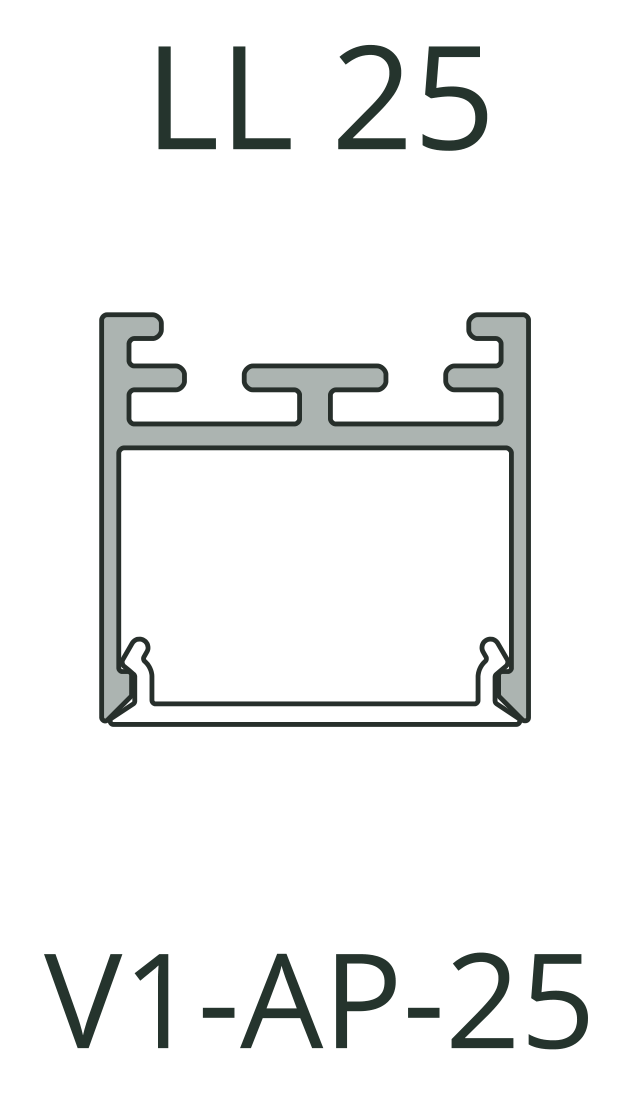
Confirmed combinations
Quickly spot the differences.
| Visible profile | Cover | Mounting method | Special feature |
|---|---|---|---|
| LL2515 | V5-U-2510 | Recessed · surface-mounted · pendant | Broad, sculptural light output; match installation and LED output to the surroundings. |
| LL25 | V1-AP-25 | Recessed · surface-mounted · pendant | Flush finish. In the system installation with a lateral shadow gap. |
| LL25 | V5-U-2510 | Recessed · surface-mounted · pendant | Raised cover as a deliberately visible lighting element. |
| LL25 | V2-UP-35 | Installation only | Lateral cover wings for connection to the structure. |
| LL25 | V3-UP-50 | Installation only | Wider cover wings for the installation situation. |
| LL35F | V1-AP-25 | Installation only | Visible aluminium flanges on the profile. “AP” in the cover name is not an approval for surface-mounting. |
| LL2511E | V6-E-2511 | Recessed · surface-mounted · pendant | 45° angled light output with matching corner cover. |
Further lighting tasks
Indirect, recessed or especially small.
With V1, LL2515 can be designed as a recessed light line for installation. The rear V4-HL-25 complements matching LL profiles for indirect light; with LL2509 this creates a flat mini light profile.
LL1606 and LL2006 form stand-alone mini applications with the matching Mini LL cover. Depending on the article, this cover is PC and must not be equated with the PMMA covers of the rest of the family.
Sample the cover and LED strip together: uniformity, light output, colour rendering and glare result from the specific combination.