

Outdoors. By the water.
Suited to the environment.
Protection rating, potting and material resistance answer different questions. The right light line takes all three into account – from dry interiors to demanding outdoor applications.
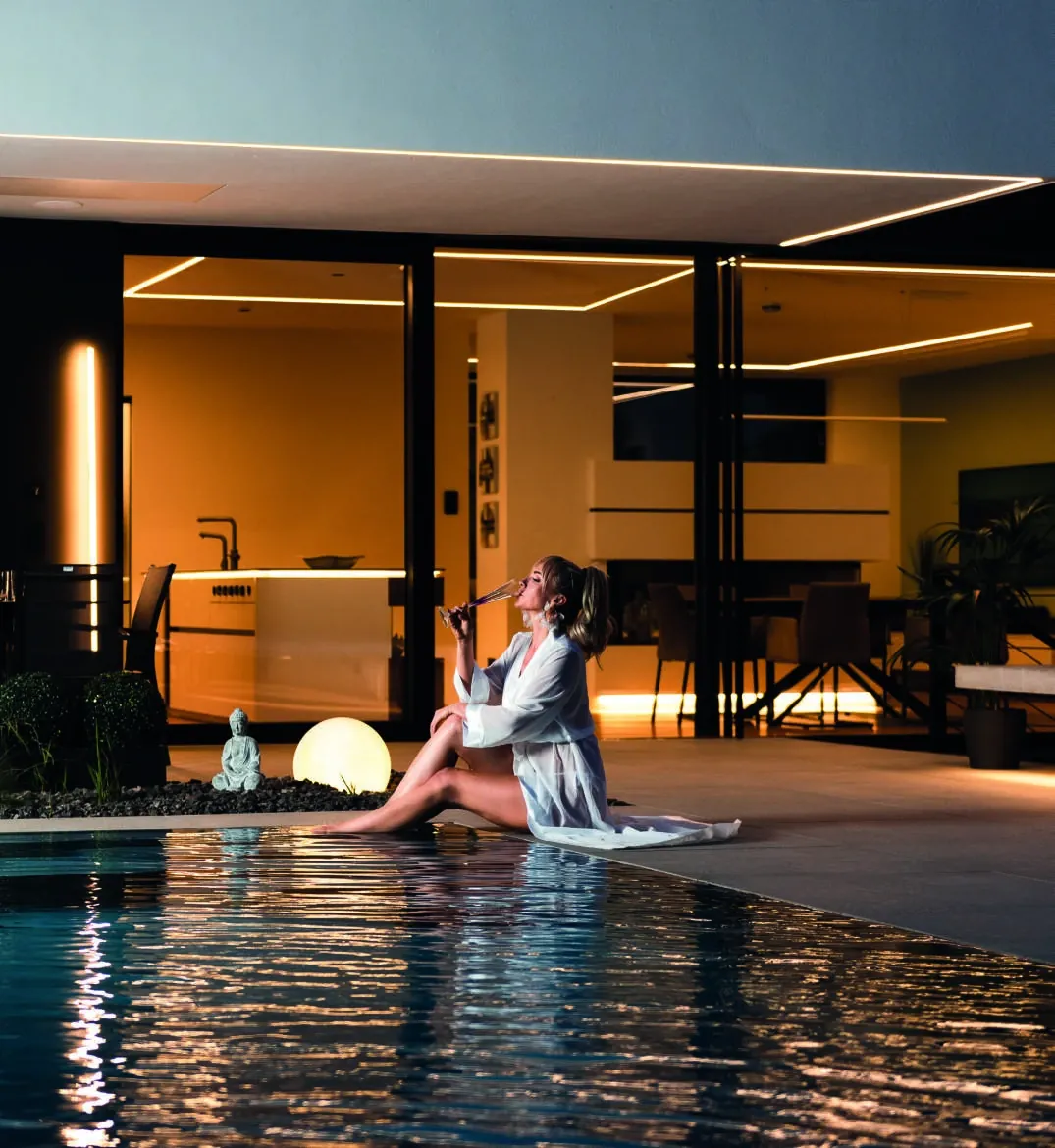
Water is one issue.
The environment is more.
The IP rating describes protection against contact, foreign objects and water. Chlorine, salt water, UV light, cleaning agents, temperature and fire behaviour require their own product-specific evidence.
| Examples of LED strip assemblies | A suitable starting point for selection | Important limit |
|---|---|---|
| IP20 · unprotected | Dry interiors, furniture and display areas. | No protection against water; no direct exposure to chlorine or salt. |
| IP54 · thin coating | Damp interiors and highly protected installation locations. | Rear side and ends remain critical; not a starting point for pool areas. |
| IP65 · Silicone coating | Suitable protected outdoor areas and applications with splash or jet water. | No immersion; do not infer chlorine/salt suitability from IP65. |
| IP67 · Tube or hollow extrusion | Damp outdoor applications and, where applicable, temporary immersion as tested. | Seal ends and connections. Hollow tubes affect heat dissipation; no blanket continuous operation in pool water. |
| IP68 · filled tube or solid extrusion | Demanding damp and underwater applications, if confirmed for this purpose. | Immersion depth and duration apply per product. Check pool and sea water, temperature and Tc separately. |
IP68 full potting for the right application.
With a fully potted light insert, the light source and the intended assembly are built as a protected unit. This differs from a merely coated flex strip or a clip-on cover.
Ready-assembled IP68 linear luminaires based on LL25 are documented for LightLineLed. They combine the profile with a defined light source and the intended connection. A standard profile combination with a cover therefore does not automatically receive the same protection rating.
Full potting changes the thermal conditions. Aluminium profile, W/m, environment and LED Tc remain part of the design. Depending on the build-up, a power reduction and a temperature check are required; the specifications of the chosen LED strip and light insert are decisive.
LL25 IP68 luminaires in the article master data.
| Light variant | Article · anodised / black / white | Assignment |
|---|---|---|
| 3000 K · 10 W/m | 280384 / 280385 / 280386 | 750 lm/m according to article master data; 2 m version. |
| 3000 K · 15 W/m | 280387 / 280388 / 280389 | 2 m version. |
| RGBW · 19 W/m | 280390 / 280391 / 280392 | Colour control plus white channel; 2 m version. |
| Tunable white · 19 W/m | 280393 / 280394 / 280395 | Adjustable white light effect; 2 m version. |
- Operating voltage
- 24 V
- Cross-section as per article master data
- 25 × 25 mm
- Standard length of the stated articles
- 2,000 mm
- Ambient temperature
- −20 to +40 °C
- Colour rendering
- CRI > 80
- Dimming
- PWM via a suitable upstream controller or suitable supply
- Control gear
- Driver not included
For the IP68 articles mentioned, the current article master states salt, chlorine and UV resistance as well as abrasion and stone-chip resistance. The specific stress is coordinated with MPW during selection. The chemical properties also described there are not a general approval for every solvent, every concentration or every cleaning method.
Source: MPW LightLineLed article master data, November 2026, articles 280384–280395. The technical summary contains no commercial data.
Chlorine, salt, UV.
Asking the right questions.
| Influence | Documented scope | Clarify for the project |
|---|---|---|
| Chlorine / pool environment | The PMMA data sheet gives no indication of damage at typical pool concentrations of approx. 0.3–0.6 mg/l. The LL25 IP68 finished luminaires mentioned have their own chlorine specifications. | This PMMA specification is not an approval for end caps, clips, metal surfaces or the complete luminaire. Higher concentrations or shock chlorination are not covered by it. Coordinate water chemistry, temperature and the actual product. |
| Salt / coast / seawater | The LL25 IP68 ready-made luminaires mentioned have their own salt specifications. For other assemblies, the proof of resistance must be checked separately. | Salt spray and permanent seawater are different exposures. Take surfaces, cut edges, contacts and connecting parts into account. |
| UV / direct sunlight | PMMA is documented as a UV- and weather-resistant cover base. Silicone build-ups are chosen on the basis of specific UV evidence. | Do not generalise the statement to PC covers, adhesives, cables or all plastics. |
| Cleaning / chemicals | The agents actually used must be compatible with the materials used. | Record medium, concentration, pH value, exposure time and temperature; no blanket high-pressure approval. |
Cut, connect,
seal and test.
Cutting, soldering and changes to connectors can cancel the documented protection rating of an LED strip. Ends and cable outlets must be resealed and tested using the procedure intended for this version. Treat factory-potted units according to their processing instructions.
Match control gear, electrical connections and terminals to the actual installation location. Building waterproofing, drainage and access are planned independently of the IP rating of the light source.
MPW supports the selection with the matching article variant, lighting equipment and version. The specific combination is determined based on the project conditions.
Light line found.
We'll clarify the details together.
Building material, surface and desired lighting effect set the direction. MPW supports you with the right system version and the next steps.