


Practical know-how 01 · Power feed & 48 V
Split the power. Understand voltage drop.
100 W, centre feed and the advantage of higher voltage – with comprehensible examples.
What does "100 W per feed-in" mean?
The output of a line of light is the result of watts per metre × length. The current flowing in the process loads the supply cable, contacts and conductor tracks. That is why the feed-in is an electrical limit – not just a question of whether the strip still lights up.
The frequently used figure "100 W" is rounded for the documented 24 V LightLine and SmallLine strips. The associated notes state a maximum of 4 A per feed-in. Calculated exactly, that is 24 V × 4 A = 96 W. For design purposes, the smaller, binding limit value applies.
Calculation example for 24 V and a maximum of 4 A
The table shows only the calculated power limit. The practically permissible length may be smaller due to strip approval, voltage drop, connection and cut pitch. Do not round up.
| Strip output | One branch · up to 96 W | Two branches · up to 192 W combined |
|---|---|---|
| 6 W/m | 16.0 m | 2 × 16.0 m |
| 10 W/m | 9.6 m | 2 × 9.6 m |
| 15 W/m | 6.4 m | 2 × 6.4 m |
| 22 W/m | approx. 4.36 m | 2 × approx. 4.36 m |
Calculation: length = 96 W ÷ power per metre. No blanket approval for these strip lengths.
Feed in the centre: two shorter paths.
If the supply is in the middle, two strip sections can be fed to the left and right. Each branch receives a suitably dimensioned connection and stays within its permissible load. Under these conditions, the total output and length can double compared with a single branch.
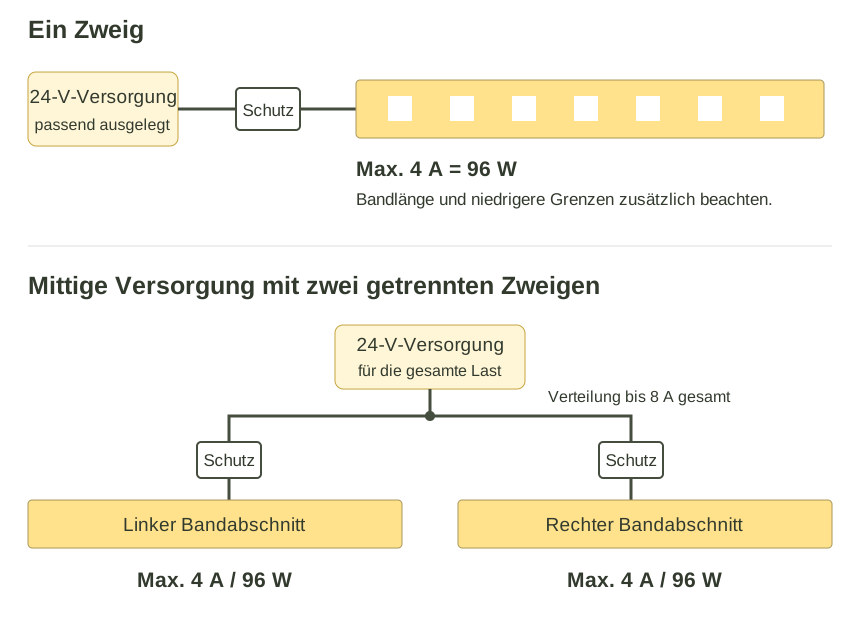
The common supply line, the distribution board and the power supply must carry the total current. With two times 4 A, that is up to 8 A. A single contact does not become more heavily loadable because the strip then continues in two directions.
Feeding in from both ends is a further option, provided the specific version and the power distribution are suitable for it. Use the same approved supply for this. Do not connect the outputs of independent power supplies without explicit approval for parallel operation.
Why 48 V relieves the supply cable.
At the same power, the current halves from 24 to 48 V. With unchanged cable resistance, the voltage drop in volts therefore halves; the power loss in the cable falls to a quarter. 48 V does not eliminate voltage drop, but makes it easier to supply longer runs.
| Comparison at 100 W load | 24 V | 48 V |
|---|---|---|
| Current at nominal voltage | 4.17 A | 2.08 A |
| Voltage drop of the example supply cable | approx. 0.97 V | approx. 0.49 V |
| Percentage of nominal voltage | approx. 4.1 % | approx. 1.0 % |
| Power loss of the supply cable | approx. 4.1 W | approx. 1.0 W |
Comparison calculation, not a connection approval: 10 m single cable length, outgoing and return conductors of copper, each 1.5 mm², specific resistance 0.0175 Ω·mm²/m at approximately 20 °C. Without contact losses and without voltage drop in the strip. The 100 W comparison is not a permissible 4 A strip at 24 V.
A larger conductor cross-section, a shorter supply cable or a more favourable distribution of the feed points reduce losses. Current-carrying capacity and fusing are checked additionally; this calculation does not replace their design.
Installation documents & drawings.
Protection ratings & ambient conditions
Selection guide for coating, tube and potting as well as moisture, UV, salt and chlorine.
Download PDF Processing in detailFrom planning to commissioning
Work steps, assembly drawings and typical errors clearly explained.
Read the installation notesOperating and installation instructions as PDF
Notes on cutting, connecting and installing LED flex strips. When selecting the protection rating and intended area of use, also observe the notes under "Protection ratings & environmental conditions".
Download PDF