


Practical knowledge 02 · Protection ratings & moisture
The right protection does not end at the strip.
IP54, coating, hollow tube and potting: what they achieve and what matters when sealing.
Protection rating and protective build-up are two separate specifications.
The IP rating describes protection against contact, foreign objects and water. It does not automatically describe the material or its resistance to UV, salt, chlorine and cleaning agents. The electrical protection class is again a different property.
| Protection rating | What the water protection describes | Points to note when planning |
|---|---|---|
| IP20 | No water protection | Dry, suitable interior areas. |
| IP54 | Protection against splashing water | Not approved for water jets or immersion. |
| IP65 / IP66 | Protection against water jets / powerful water jets | No blanket protection against high-pressure or steam cleaning. |
| IP67 | Temporary immersion under test conditions | No automatic approval for permanent underwater operation. |
| IP68 | Immersion under defined conditions | Confirm depth, duration and medium for the specific installation. |
A higher final digit does not automatically replace every other water test. For water jets and immersion, separate verification may be required.
IP54: thin sealing, targeted use.
The IP54 version described here protects the strip with a silicone spray coating. The term nano-sealing is also used in connection with thin protective layers. However, no specific nanotechnology or coating chemistry can be derived from "IP54" alone.
A thin coating protects the surfaces designed for it and affects heat transfer less than a solid protective sheath. The rear, cut ends, solder and connection points remain areas requiring particular attention. It does not turn an open connection into a protected installation.
Hollow tube: a small cavity of great importance.
In a tube that is not completely potted, there is a volume of air between strip and sheath. If the air heats up during operation and cools down later, pressure differences can arise. On cooling, negative pressure can occur. If there is a leak at ends, cuts or cable outlets, moisture can thereby enter the supposedly protective tube.
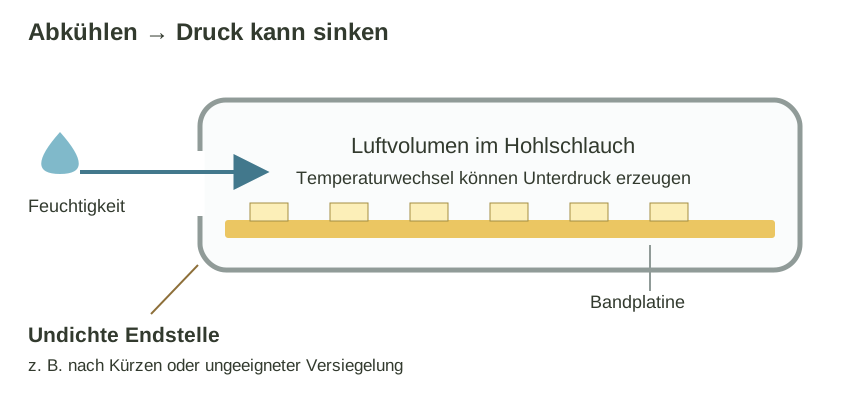
The pressure mechanism is known from studies of sealed luminaire housings. Applying it to an air-filled strip sheath is a technical inference; extent and behaviour depend on construction, flexibility, tightness and temperature changes. Condensation and capillary paths along cables must also be considered during planning.
Especially critical: shortening and sealing the end only superficially, using an unsuitable sealing compound, cutting the curing time short or subjecting the cable outlet to tension. The tube only protects as intended if the entire system is closed correctly.
Choose full potting and IP68 deliberately.
A filled or solid construction avoids the continuous air gap of a hollow tube. This still does not amount to a general approval for seawater, swimming pools, any depth or any cleaning agent. Potting can also make heat dissipation more difficult.
For OceanX and other IP68 versions, we agree immersion depth and duration, water quality, temperature, cable routing and the desired length. Plan connections that are as fully pre-assembled as possible; subsequent interventions must follow the approved procedure.
After shortening: restore protection.
- Determine the version. Use the instructions matching strip and protective build-up and the approved sealing system.
- Separate and connect cleanly. Check interface, contacting and polarity. Do not trap moisture or dirt.
- Seal completely. Treat both ends, transitions and cable outlets. Observe material compatibility and the prescribed curing time.
- Relieve and check. Keep tension, bending and chafing away from the sealing point. Check the finished build-up according to the intended application.
Installation documents & drawings.
Protection ratings & ambient conditions
Selection guide for coating, tube and potting as well as moisture, UV, salt and chlorine.
Download PDF Processing in detailFrom planning to commissioning
Work steps, assembly drawings and typical errors clearly explained.
Read the installation notesOperating and installation instructions as PDF
Notes on cutting, connecting and installing LED flex strips. When selecting the protection rating and intended area of use, also observe the notes under "Protection ratings & environmental conditions".
Download PDF